


According to a new study, checking accounts at the nation’s ten largest banks come with a median length of 111 pages of disclosure documents. Getting to the bottom of all of your account’s requirements, fee schedules, addendums, and other terms and conditions is like reading a short novel—a horrendously boring, annoyingly legalistic, and purposely confusing novel.
Or, in terms of length if not quality of storytelling, a checking account’s disclosures are more than double William Shakespeare’s “Romeo and Juliet,” according to The Pew Charitable Trusts, which conducted the study. The play and the confounding, absurdly long disclosures accompanying checking accounts have something else in common: They’re both unfortunate tragedies that could have been avoided.
While it’s too late for the star-crossed lovers, checking accounts don’t have to be doomed to a fate in which customers are confused and can’t find key terms and conditions while sifting through more than 100 pages of tiny type on brochures and websites.
The Pew study offers some simple suggestions—the main one being a means to clarify and significantly scale down all the disclosure. Specifically, banks should:
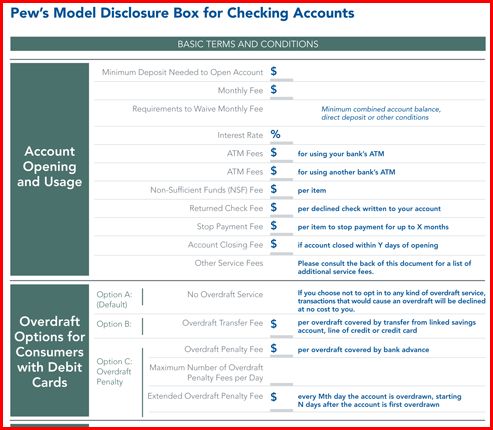
provide information about checking account terms, conditions and fees in a concise, easy-to-read format, similar to the Schumer Box used for credit cards
Part of the box might look like this:
The Pew study also recommends that banks start providing better, fuller, less confusing information concerning overdraft options. Another study published this week, from the Center for Responsible Lending, showed that more than half of bank customers who opt for overdraft protection don’t fully understand what the “protection” does and does not do.
How could things change so that customers actually grasp what they’re opting into or out of? To begin with, banks could just stop tripping up customers by referring to overdraft charges with all sorts of different names and phrases, like:
Overdraft item fee
Insufficient funds fee
Overdraft fee
Overdraft items paid fee
Returned/paid item fee
Unavailable funds penalty
Unavailable funds fee
These are all essentially the same damn thing, which, Pew researchers point out, makes it difficult for consumers to understand what’s what, and to compare accounts among and within banks.