


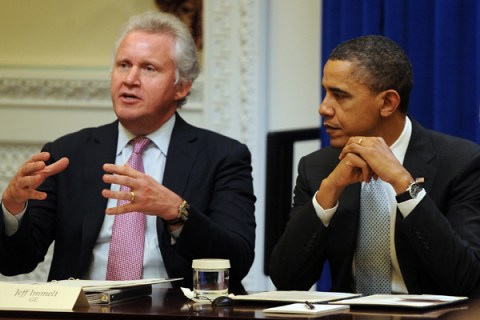
Jeff Immelt, President Obama's jobs czar.
At the start of the week, Jeff Immelt, the CEO of GE and the head of President Obama’s task force on job creation, released an interim report on plans to boost employment in the U.S. The reactions have been relatively predictable. Immelt himself has come in for criticism — fair or not — as a corporate titan who has overseen job creation abroad and job destruction at home, and there has been no shortage of voices pointing to GE’s global profits that have not been subject to American taxation.
Of course, it isn’t just Immelt. The council is composed of a number of prominent CEOs, including Ken Chennault of American Express, and overall, the initiatives proposed by the Jobs and Competitiveness Council have received mixed reviews. The council calls for more vocational education to train unemployed workers with the skills needed for today’s more complicated manufacturing jobs. It suggests green and energy efficiency makeovers for buildings as a source of construction jobs, urges that policies to encourage foreign tourism in the U.S. will boost economic activity, and advocates more government-backed small business loans. The council also promises to report back in 90 days with more strategic and long-term solutions.
The criticisms divide into predictable left-right argots. The left decries the assumption underlying the report that unemployment in the United States is more structural than cyclical (because structural explanations appear to let corporate America and Wall Street off the hook) and urges more expansive government action to get economic activity moving. There is also the belief that employment is being undermined by rapacious multinationals epitomized by GE and others and hence the calls for more regulation of capital and greater taxation of corporate profits.
[time-link title=”(Read more about jobs czar Jeff Immelt at The Curious Capitalist)” url=http://curiouscapitalist.blogs.time.com/2011/06/13/obamas-jobs-czars-plan-will-it-lower-unemployment/]
The right, meanwhile, has had it with more government answers to what it perceives as free-market problems. Whether unemployment is structural or cyclical, the right doesn’t believe that the federal government should be spending one more dime or one more minute on solving an issue that is a product of business cycles. For them, this entire endeavor spearheaded by the White House and Immelt is part of the problem.
Yes, there is a third option here that both sides miss: Government may be neither part of the problem nor part of the solution. It may simply be irrelevant to whether or not long-term unemployment in the United States gets better, worse, or stays the same. That could be true in either the structural or cyclical scenario. Personally, I’m of the view that the current unemployment problem is not simply a lingering effect of the recent financial crisis and recession but is rather a reflection of changing patterns of global trade, manufacturing, and capital. Regardless, the jobs council and the White House act on the presumption that decisions and policies made in Washington can shape outcomes and affect the trajectory.
More sobering is the possibility that in a globalized world of trade, commerce and capital, labor is another commodity that cannot be controlled by any one government except by erecting very high barriers to global commerce with consequent costs or by spending vast sums to prop up wages and safety-nets. Outcomes can be made better or worse at the margins, but that’s about it.
[time-link title=”(Is rising unemployment President Obama’s fault?)” url=http://curiouscapitalist.blogs.time.com/2011/06/09/is-rising-unemployment-obamas-fault/]
That possibility isn’t considered because it threatens our collective belief that problems can be directly addressed by coherent collective action. That’s a comforting notion, and at times, I wish it were true. Once, it may have been, but now and tomorrow, no. Perhaps the only thing government can do to create jobs is actually to create jobs, by hiring millions of workers in a New Deal-style Works Progress Administration government jobs program (which has to recommend it the actual manifestation of real jobs using money we are already spending on unemployment benefits). Other than that, all of the ideas – brilliant or befuddled – proposed by the jobs council may be just so much noise, interesting maybe, provocative perhaps, but noise nonetheless.