


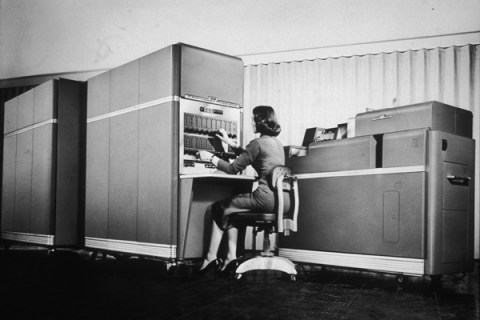
A woman sitting at a massive IBM computer in the 1950s.
Today, IBM officially marks its 100th anniversary. But the company today bears remarkably little resemblance either to the sleepy Computer Tabulating Recording Corporation that was formed on June 16, 1911, or to the more iconic International Business Machines (renamed to one-up then rival National Cash Register in the 1920s) that was one of the dominant companies during the brief but spectacular American century.
In fact, IBM today is one of the great stories of a company pulling out of a death spiral and reinventing itself. Its heyday was in the 1960s, when it was an integrated mainframe computer company with perhaps the best sales force in the United States. It enjoyed intimate connections with government as well. But by the late 1980s, the once-impregnable Big Blue was suffering, its core businesses losing share rapidly to competitors ranging from Microsoft to Intel to a wave of new PC makers. At the beginning of the 1990s, the company was no longer profitable, its workforce was bloated and ineffective and it seemed likely to soon join the ranks of once-great and now extinct U.S. companies.
That didn’t happen. Instead, two CEOs, first Louis Gerstner and then current-CEO Sam Palmisano transformed the company. Having been a computer hardware company selling large, very expensive machines primarily to businesses, IBM has today become a global software and consulting company that offers bespoke solutions that allow companies, governments and large organizations around the world to operate more efficiently and effectively. It has also become a leader of sustainable business practices, helping companies reduce their use of natural resources in order to maintain profitability in a world where input costs are skyrocketing but the ability of companies to pass on those costs is limited.
[time-link title=”(Read about the ‘Jeopardy!’-winning IBM computer)” url=http://techland.time.com/2011/05/23/jeopardy-winning-computer-delving-into-medicine/]
Changing a corporate culture that has evolved over decades and produced unparalleled success is incredibly hard. That is why it is so rare. IBM morphed from a tight-knit, hierarchical U.S. company that made big machines and sold them expertly into a diverse, global organization with far more workers outside the U.S. than in it. It is a global consultant that helps cities reduce their red tape and their energy use, allows companies to rationalize complicated global supply chains and makes it possible for multinationals to figure out their human resource needs. It still sells hardware and systems to implement those solutions, but with the emergence of cloud computing and virtualization, less and less of its business consists of stuff and more and more is composed of ideas and knowledge. Its annual revenue exceeds $100 billion.
[time-link title=”(Read about how IBM is still changing the way we live)” url=http://techland.time.com/2011/06/16/techland-interview-how-ibm-is-still-changing-the-way-we-live/]
Like any organization, it has its flaws. People who have worked for IBM complain that for all the efficiencies and decentralization, it still suffers from the legacy of a large lumbering corporation and has layers of bureaucracy that can slow things down. The company has also continued to shed jobs in the U.S. and add them abroad. Though exact numbers are hard to come by, it almost certainly has more workers in India (c. 120,000) than in the U.S.
[time-link title=”(Read about how Apple is on pace to best IBM by 2013)” url=http://techland.time.com/2011/03/25/analyst-apple-to-double-growth-outpace-ibm-by-2013/]
But the nature of its current business and how it has transformed over the past decade is Exhibit A for how the American economy must continue to evolve. Its business today addresses the greatest challenges the world faces: how to feed, clothe and house hundreds of millions of new entrants into the middle class and provide the same material advantages those in the Western world have enjoyed for decades. American companies remain the dominant global providers of complicated yet usable ideas, and that is a competitive advantage that IBM represents as well as any. It is a model for the way forward, and for that alone, its 100th birthday is an anniversary to celebrate.
Correction: In an earlier version, IBM was incorrectly described as merging with National Cash Register. The company was renamed to compete with then-rival National Cash Register.