


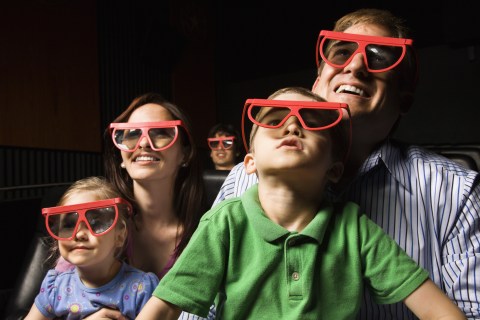
Generally speaking, movie goers love special effects. For an action film in which giant robots come to life and battle for the earth’s survival, it’s a safe assumption that the more special effects, the better. But what if audiences regard one particular effect as annoying and occasionally nauseating—and not only because it makes theaters charge an extra few bucks per ticket?
Movie fans, it seems, have fallen out of love with 3-D. Were they ever in love to begin with? “Avatar” in 3-D was an event not to be missed. More recently, however, it appears as if the the new “3-D effect” is that the effect factors in to people’s decision to skip the film or just see the 2-D version. More than half of the movie goers who sat through the latest “Pirates of the Caribbean” movie selected 2-D, rather than the pricier 3-D version. (Given the reviews, it’s arguable that they all overpaid.)
In terms of TV, couch potatoes are even less willing to pay extra for 3-D, despite the relentless marketing push. Reports have surfaced forecasting that this is the year many consumers will upgrade to a 3-D TV, and that roughly one in five new LCD units will be 3-D units. If they do sell in large quantities, it’ll likely be because, as Techland reported, prices on 3-D TVs are dropping rapidly, with some models going for under $700.
If 3-D TV was in high demand, such price wars wouldn’t be happening. And if 3-D at the movies was in high demand, director Michael Bay wouldn’t have to be campaigning with the public that it is absolutely worth an extra $3 to $5 to see his new movie, “Transformers: Dark of the Moon,” in 3-D.
(LIST: ‘Bueller? Bueller?’ Top 10 Quotable Movies)
But that’s what he’s doing, per the NY Times, which takes a subtle jab at the visionary behind epic, but confusing and ultimately silly movies such as “Pearl Harbor” and “The Rock”:
This is unfamiliar territory for Mr. Bay, who usually has to defend the narrative arc of his films, not the visuals.
The Times reports that movie theaters and companies that specialize in 3-D production technology are both hurting, largely because the hot new product isn’t resonating with their customers. Especially not if the product costs an extra $5, and most people prefer the original product anyway. There’s something very “new Coke” about this, in which the business side has vastly overestimated its ability to anticipate what customers want, and what they’re willing to pay for. At least when Coca-Cola introduced new Coke, it didn’t charge extra for it.
There are all sorts of reasons why different movies are filmed in 3-D. Mostly, though, it’s because theaters get to charge extra admission when the movie is shown in 3-D. In the last quarter of 2010, per Hollywood Reporter, the average ticket price rose over $8 for the first time ever, largely because of more movies were in 3-D and more theaters got to charge a premium for admission.
Now, after movie goers have come to realize that the 3-D is underwhelming, annoying, distracting, or just plain more marketing hype, Bay and his ilk are being forced to re-hype the hype. One movie executive quoted by the Times basically admits that much of the 3-D in recent films has been weak and pointless:
“The consumer has had a reaction to bad 3-D and subtle 3-D,” said Rob Moore, Paramount’s vice chairman. “They’re tired of sitting in a theater thinking, ‘Wait, is this movie in 3-D or not?’ Well, with ‘Transformers’ people are going to leave saying, ‘You absolutely must see this in 3-D.'”
The movie opens next week—IN MIND-BLOWING 3-D! if you hadn’t already heard. We’ll soon see if the effects are truly “more than meets the eye” (cue robot transforming sound), or if that extra $5 is more than movie goers feel like paying.
(LIST: Top 10 Superhero Movies)