


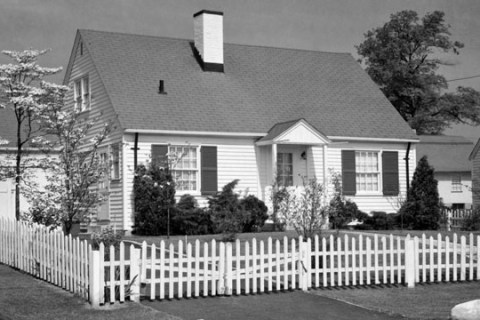
Americans have long overindexed on the value they place on owning a home when compared with people in other western countries. That white picket fence in the age-old imagery of the American Dream? That stands for real estate.
And according to a poll released Wednesday by the New York Times and CBS News, home ownership still holds its hallowed status in the minds of 89 percent of Americans, who say homeownership is still an important part of that American dream despite the dire real estate recession that has gripped the nation’s housing market for the last four years.
(PHOTOS: Top 10 Most Affordable Cities for Renters)
Though the recession has done little to dampen respondents’ value on homeownership as an institution, the lines along which the real estate market meltdown has played out has caused Americans to assign blame for the crash. Participants in the survey spread this blame with a very wide blade:
- 45 percent say the government should be doing more to boost housing;
- only 36 percent approve of President Obama’s real estate market interventions;
- 42 percent point their fingers at subprime-loan originating, robo-signing mortgage lenders; and
- 29 percent place blame at the feet of the regulators they feel allowed this mess to happen.
Only 12 percent assigned responsibility for the housing crisis to borrowers themselves.
These survey results differ in scale, but not direction, from a number of other recent surveys that have found the value Americans’ place on homeownership to be recession-proof. But when you look a little deeper into the data, some interesting insight emerges into the contours of how Americans view real estate.
Economists might scratch their heads at the idea that such a poorly performing investment class is still held in such high esteem. If investors’ stock portfolios were currently at their 2002 values, as is real estate nationwide, according to the S&P Case-Shiller Home Price Index, it’s highly unlikely 90 percent would still profess their love for stocks.
(MORE: Is it OK to Walk Away from Your Mortgage?)
And the NYT/CBS survey ferreted out some nuances on this point. For instance, when asked whether buying a home is generally a safe or risky investment, 49 percent said safe while 45 percent deemed it risky. The survey also asked respondents which investment — among stocks, savings, 401Ks and IRAs, and their homes — was the best long-term investment for an American today. Only 26 percent voted housing up as the best investment.
So, 45 percent thing housing is risky and 74 percent think something else is a better investment, but 89 percent still see it as part of the American Dream?
The only reasonable explanation lies in the essential difference between a dream and a smart financial decision. The fact that people value homeownership, or they say they do when asked, doesn’t mean they can afford to, can qualify to, or are willing to buy into a down market, as any real estate broker or agent can attest. This explains the massive gap between Americans’ overwhelmingly bullish take on housing overall and every other housing indicator out there, from dismal home values to super-slow sales activity (notwithstanding the seasonal 8 percent May bump in pending home sales the National Association of Realtors reported yesterday).
That means that the American Dream is not necessarily a dream about profits or upside. It’s a dream about designing and keeping maximum control over your own lifestyle, tax-advantaged. It’s about the prospect of one day owning where you live, free-and-clear.
Survey respondent Donna Boyd expressed as much in her follow-up interview. Despite believing “it might take a long time” for property values to recover,” she went on: “I don’t think I’m throwing my money away. I rented for years when I was younger, and I just don’t like the idea of putting money in someone else’s pocket for something I will never own.”
And, apparently, neither do the vast majority of Americans, who still factor the picket fence (or urban condo, as the case may be) into their version of the American Dream.