


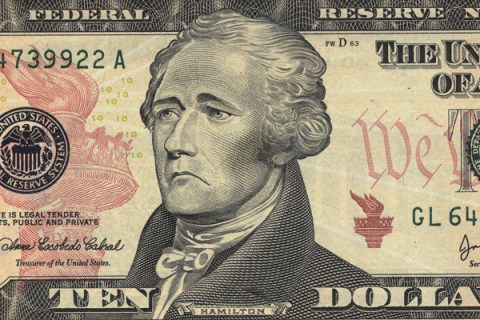
One of America’s favorite pastimes is to play the “what would the Founding Fathers say” game. Just pick an issue du jour, and ask the question. Given that today’s world (Google, Twitter, television) is probably way beyond even the imagination of the 18th-century designers of the Constitution, the game usually says more about today’s partisan fights than about the Founders.
But on one contemporary issue the Founding Fathers did have strong opinions: the national debt. Had they been confronted with the question of whether the federal government should be allowed to default on its debt obligations, they would have spoken with one resounding voice: No! Pay the bills, service the debt. Don’t even think of defaulting or playing dice with global creditors for domestic political gain. End of argument.
(MORE: The Constitution: One Document, Under Siege)
How do I know this? One of the glaring weaknesses of the system set up by the Articles of Confederation, which governed the new United States in the 1780s before the Constitution, was the inability of the central government to raise revenue through direct taxation. The U.S. could not print national currency, and it was unable to do much about the debt incurred by the states during the Revolutionary War, which, as a young nation, was substantial. The result was a chaotic economic situation of competing state currencies, unmet debt obligations to both foreign and domestic creditors (including salaries of war veterans) and an inability to integrate the new nation into a global trading system. The drive to write a new Constitution was fueled by the clear need to empower a national government with a modicum of economic sovereignty.
Proof of that can be found in a legion of quotations and letters, ranging from speeches to the Federalist Papers. James Madison, architect of the nation if there ever was one, described national debts as “moral obligations” in Federalist Paper No. 43. George Washington, who was always measured and diplomatic in public utterances, was unequivocal in his thoughts on public debts: “No pecuniary consideration is more urgent than the regular redemption and discharge of the public debt; on none can delay be more injurious, or an economy of the time more valuable.” And that message was delivered directly to the House of Representatives in 1793, where some members were contemplating various defaults.
(VIDEOS: Check out TIME’s series of 10 short videos on the Bill of Rights)
We should, of course, be wary of cherry-picking quotations. The Fathers were verbose and voluminous in their correspondence, and just as the devil can quote scripture, you can find one of the early leaders of the U.S. saying nearly anything. But few if any were saying, “Sure, let’s default and ruin our international credit and national economic system.” Yes, before the new federal government, the confederation of states was in constant risk of default simply because there was no agreed notion of public good. But once the union had been formed, there was a rough consensus – save for those who actively wanted the union to dissolve and the experiment of the U.S. to fail.
Finally, there was Alexander Hamilton, who is, in many respects, the founder of our national economic system. He saw public debts and national responsibility as one of the pillars of the union. “States, like individuals, who observe their engagements, are respected and trusted; while the reverse is the fate of those who pursue an opposite conduct.” Hamilton also – and more controversially – saw the national debt as a glue for the union, binding disparate elements together in a web of mutual responsibility.
While the virtue of a national debt can be debated (and certainly was in Hamilton’s day), the principle that once it exists it must be honored should be unarguable. The preponderance of the Founding Fathers would have said as much, vociferously. They would have been appalled at the argument of those who invoke the Tea Party to renounce debts. The way out of debt is not to refuse to pay, or to risk the credit of the country.
The nation’s creators might well have been appalled that our national government accrued so much debt and spent so much on credit, but it is hard to see any of them contending that the way out of that bind is to refuse to pay.
But that is what is being contemplated. The United States has a lot of debt, yes, but we’re not Greece. There is no inability to pay, and no threat from global creditors that credit may be cut off. In time, perhaps, but not now. For those who still look to the Founders for wisdom and guidance, on this celebration of another Independence Day the message is clear: Argue all you want about the proper role of government and levels of debt. Debate and contest, rowdily and angrily. Get down and dirty. But above all, do not sacrifice the nation’s credit on the altar of political expediency and partisan gain.