


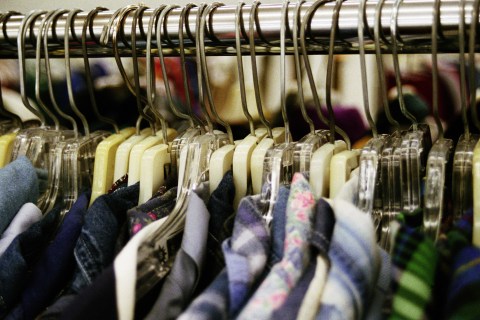
How’s this for an unorthodox economic indicator: Stores selling secondhand merchandise on the cheap are absolutely booming.
Thrift stores run by the likes of Goodwill, St. Vincent De Paul, the Salvation Army, Savers, and independent operators have all been reporting better-than-average business lately.
The Los Angeles Times, for instance, reports that Goodwill stores in southern California are on pace to record-breaking sales this year, while sales at one St. Vincent De Paul store were up 16.5% in April, compared to the year prior.
This isn’t merely a SoCal phenomena. Thrift stores are booming everywhere from Modesto, California, to Kansas City, Missouri, and beyond. The Savers chain of non-profit thrift stores opened its 250th store last fall, and at least 19 more locations are opening in 2011.
(MORE: Invasion of the Discount Retailers!)
The obvious explanation for thrift stores’ success is that, given today’s economy, people have less money to spend, and they’ve come to realize their money will go further at thrift stores than it will at more traditional shopping hubs. One shopper explained to the LA Times:
If you know what you’re looking for, she said, a $20 bill will get you five or six items of better quality than a single $20 item at Target.
For some shoppers, hitting the thrift stores is the only affordable way to clothe their families and furnish their homes. For others on newly strict budgets, thrift stores allow them to still feel the thrill of the shopping treasure hunt while spending a fraction of the equivalent excursion to the mall. Whatever stigma that existed regarding secondhand stores is long gone, replaced by the idea that pre-loved thrift store merchandise is not only cool, but better for the environment than the freshly manufactured goods shipped in from somewhere overseas.
Some shoppers are using thrift stores not only to save money, but to make it. While holding a garment from Anthropologie that retails for around $100 but was selling for $4.99 at a thrift store, the same woman mentioned above announced her plans to buy it—and then flip it for a profit:
“I can sell this on EBay for $25,” she said, speaking with authority.
(MORE: The State of the Economy, Investing, Housing … and Brazilian Bikini Waxes)
Brad Tuttle is a reporter at TIME. Find him on Twitter at @bradrtuttle. You can also continue the discussion on TIME’s Facebook page and on Twitter at @TIME.