


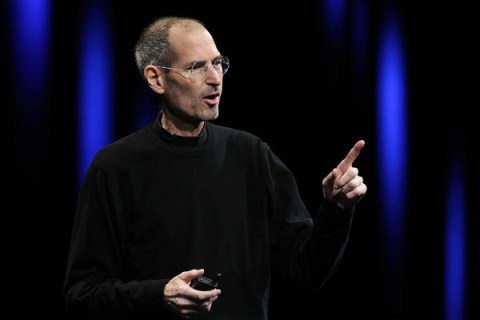
Steve Jobs institutionalized his vision at Apple.
Steve Jobs was a modern-day Thomas Edison whose achievements, including the rescue of Apple from near oblivion, will be studied by historians for generations to come. But as the world mourns his untimely death Wednesday at the age of 56, the time has come to face the fact that the company he co-founded probably never gave the public the straight picture about his health.
Ever since Jobs first admitted in August 2004 that he was undergoing treatment for pancreatic cancer, Apple has taken great pains to convince the world that the cantankerous Jobs would be as victorious over the disease as he was in business. (“A Culture of Secrecy” was how it was put in the New York Times by Joe Nocera, whose commentary on the topic probably pushed Apple to disclose what little we did know over the years about Jobs’ health.)
The reason for the PR strategy was simple — in the minds of shareholders Jobs was synonymous with Apple. People bought the stock in the hopes of somehow tapping into the genius of Jobs. Their faith in him was well-rewarded. Shares of the Cupertino, Calif.-based company have soared more than 400% over the past five years.
(GALLERY: Rare Photos: Jobs at Work)
Jobs zealously protected his privacy, and Apple’s board didn’t press him to be more forthcoming about his illness. Shareholders were kept in the dark about Jobs’ health for years. Members of the press were forced to parse the company’s vague public statements and tried to deduce whether Jobs was at death’s door by how he looked at public appearances. Eventually, the company’s PR strategy backfired by raising more questions than it answered.
In 2004, Jobs told his employees in a memo typed on a 17-inch Apple PowerBook that he had a rare but treatable form of pancreatic cancer. He said he needed a month to recover from surgery to remove a cancerous tumor and placed his trusted aide Timothy Cook in charge while he was away. The leave, though, was not disclosed until after it occurred, which raised some red flags
Concerned about his gaunt appearance, the media repeatedly raised questions about Jobs’ health in 2008, which Apple ducked. In January 2009, the CEO responded that he was battling a “hormone imbalance” but was otherwise fine, saying at the time, “the remedy for this nutritional problem is relatively simple and straightforward, and I’ve already begun treatment.” Less than two weeks later, however, Jobs announced that he was going on a six-month medical leave, saying his health issues were “more complex than I originally thought” and were becoming a distraction.
(MORE: Steve Jobs: The Great Reinventor)
During that time, he underwent a liver transplant that was not disclosed until two months after it happened. Board member Jerome Yorke told The Wall Street Journal that he was “disgusted” by how Jobs had concealed the seriousness of his illness and regretted that he didn’t resign over the issue. (Yorke died in March 2010.) An Apple spokesperson told the U.K.’s Telegraph that Jobs remained “part of the production process” while on leave without providing specific examples. Jobs returned to work that June.
When he announced his final medical leave in January 2011, The New York Times reported that Jobs hadn’t been seen in public since October and that people were increasingly concerned about his emaciated appearance. This time he offered no time-table for his return. Steve Wozniak, Apple’s other co-founder, told CBS News today that Jobs was increasingly worried about his health in recent months. There was no word of this from the company until Jobs resigned as Apple CEO in August, saying he was unable to fulfill his duties.
Let’s hope that companies learn from Apple’s missteps. Public shareholders are entitled to timely and accurate information about the health of a CEO, particularly one as closely (and correctly) associated with his company’s astounding success as Jobs.