


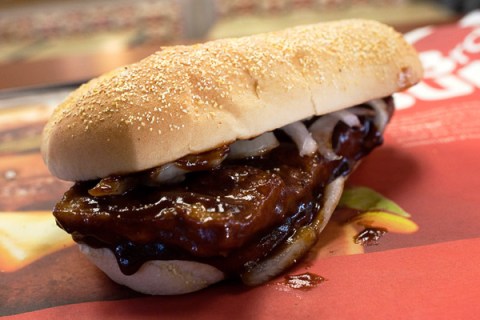
The bizarrely dedicated fans of the McDonald’s McRib sandwich are overjoyed that the barbecue-sauce-soaked boneless pork patty treat is returning for a limited time to all U.S. Golden Arches locations. But are McRib devotees simply being McManipulated?
Few fast food menu items can say they have their own Facebook page. Then again, few fast food items have experienced the rollercoaster-like ups and downs of the McRib.
First introduced in 1982, the sandwich first disappeared in 1985, but then has periodically resurfaced in McDonald’s in the U.S. and abroad. The McRib’s cult-like following has generated not only Facebook pages, but McRib Locator websites and a Twitter account.
This fall, the McRib made news as McDonald’s re-introduced it once again—this time, making it available in all U.S. locations through November 14. The obvious question is: If the McRib is so popular, why doesn’t McDonald’s sell it year-in, year-out, at all locations?
(GALLERY: 12 Things We Buy in a Bad Economy)
The answer is that, sort of in the same way that some people are attracted to bad boys (or girls) who won’t commit, the elusiveness of the McRib is part of its appeal.
Retailers understand that the words “for a limited time only!” are known to make shoppers spend in irrational ways, with the latest example being the rise of Groupon and other flash deal sites. Instead of the traditional sales pitch, in which the focus is on the quality, utility, and desirability of the product, the “limited time only” strategy plays off of the widespread human characteristic to hate missing out on something—regardless of whether or not you actually want that something.
(MORE: DVDs in the ‘Disney Vault’: Manipulative Marketing at Its Best (Worst?))
The Chicago Tribune‘s Phil Rosenthal tackles the “limited time availability” phenomena in a column discussing the McRib revival, as well as Warner Bros.’ plans to stop selling Harry Potter movies at the end of the year. Of the McRib fanatics, Rosenthal writes:
Hard to fathom they would be that hungry for a pork patty pressed into the shape of a small slab of ribs if it were a menu staple.
The limited-time-only factor succeeds in creating a sharp, sudden rise in demand that otherwise wouldn’t exist. Another prime example of such market manipulation is the much-vaunted “Disney Vault,” where Disney movies supposedly disappear after a strong marketing push. That is, they disappear until yet another digitally remastered edition inevitably surfaces later on. These efforts all artificially manufacture a scarcity, with the idea that the limited supply and limited availability produces increased demand—and more sales.
Brad Tuttle is a reporter at TIME. Find him on Twitter at @bradrtuttle. You can also continue the discussion on TIME’s Facebook page and on Twitter at @TIME.