


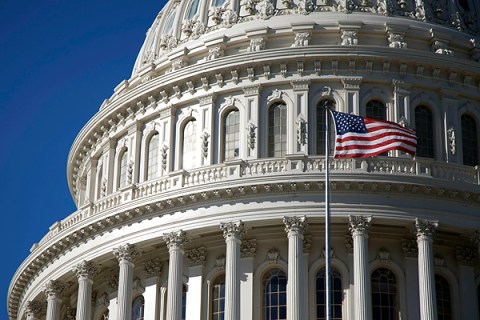
I love the holidays in Washington. Christmas trees at the Capitol, carols at the National Cathedral–and another partisan catfight over taxes.
Last year, Democrats and Republicans rang in the season with a bitter fight over extending the Bush tax cuts. That fracas ended with a less-than-statesmanlike compromise, with everyone agreeing to kick the can down the road for two years.
This December, lawmakers are bickering over another expiring provision: the payroll tax cut. Over the short term, allowing this cut to expire would be foolish. With the economy still sputtering, the last thing we need is a sweeping tax hike on people who actually work for a living. (In fact, it looks like the two sides are close to an agreement on an extension.)
(GALLERY: For Sale: The Homes of Hollywood’s Broken-Hearted)
But extending the payroll tax cut will continue a disturbing trend in American politics: the gradual demise of the temporary tax cut.
Once upon a time, politicians took it for granted that taxes should go up and down over the course of the business cycle. Economists call this demand management (while the rest of us call it Keynesianism, after its most famous advocate, British economist John Maynard Keynes).
The basic concept is simple: Cut taxes during recessions to encourage consumer spending, then raise them during booms to keep inflation at bay. (Demand can be managed through government spending, too, but let’s focus on the tax system for now.)
(MORE: Would You Watch an Ad to Avoid an ATM Fee?)
Politicians like this theory — or at least half of it. Since the end of World War II, Congress has repeatedly used tax cuts to bolster a sagging economy. They did it in the late 1940s, the early ’60s, the ’70s, the ’80s and 2000s.
Lawmakers have been less diligent about raising taxes to cool an overheated economy. Still, they’ve made the occasional stab at it. During the Vietnam War, Congress imposed a special 10% income tax surcharge to slow inflation. Similarly, debt worries in the economically vibrant 1990s prompted Congress to roll back some of the tax cuts enacted under President Ronald Reagan.
In fact, Reagan himself was skilled at demand management. The Gipper is remembered for his famous 1981 tax cut, which slashed taxes by $264 billion and helped lift the country out of a deep recession. But faced with mounting deficits (and a recovering economy), Reagan eventually took back about half the 1981 cut with a series of tax hikes. Turns out, Reagan was a pretty good Keynesian, too.
By contrast, today’s politicians lack the stomach for well-practiced Keynesianism. They are still enthusiastic about cutting taxes to spur recovery. But they’re increasingly unwilling to let “temporary” tax cuts expire.
(MORE: What Darwin Can Tell Us About Black Friday)
The problem began with the Bush tax cuts of 2001 and 2003. From the start, these cuts were temporary, with most slated to disappear at the end of 2010. But the sell-by date was a function of political expedience, not policy excellence. Arcane budget rules made it easier for lawmakers to pass a temporary cut than a permanent one, so that’s what they did. When the cuts came up for renewal, Republicans insisted that expiration would constitute a tax hike, not a return to normal tax levels. “That’s a tax increase plain and simple,” declared Sen. Orrin Hatch, R-Utah, in a typical comment.
Democrats rejected this argument, insisting that temporary meant temporary. But ultimately, Congress agreed to extend the Bush cuts – temporarily. At the end of 2012, the cuts will come up for renewal again, and we’ll get to have the same argument all over again.
In the meantime, we’ve got a good fight brewing about the payroll tax cut. Last year, President Obama convinced Congress to slash the employee portion of the Social Security payroll tax from 6.2% to 4.2%. He touted the measure as a short-term boost for the ailing economy.
But now, faced with the impending expiration of this cut, the president is channeling his GOP antagonists, insisting that failure to renew the cut would constitute a tax hike. “The question they’ll have to answer when they get back from Thanksgiving is this,” the president said last week in reference to Republicans. “Are they really willing to break their oath to never raise taxes and raise taxes on the middle class just to play politics?”
Now it bears repeating: The issue here is not extension of this particular tax hike. Withdrawing this stimulus in the midst of a sluggish economy would indeed be a mistake. But would it also be a tax hike?
No. It’s an extended tax cut. This distinction is more than semantic. If letting the payroll tax reset constitutes a tax hike this year, then won’t it be a tax hike next year, too? And the year after?
Here’s the most likely scenario. Congress, after a lot of hemming and hawing, will extend the payroll tax cut temporarily. Next year, Democrats will argue for another extension, and Republicans will agree again. Rinse and repeat indefinitely.
When, exactly, will that process end? When will anyone stand up for the idea of raising taxes on almost every working American? Never. So the payroll tax will be incrementally extended through a series of renewals. It will be made permanently temporary.
The demise of truly temporary tax cuts is no big deal – assuming you don’t plan to use tax-based stimulus as a tool for fighting recessions. But demand management requires revenue flexibility. If tax policy only goes one way – down – then we won’t have the tools we need to keep the economy healthy.
And that would be a tragedy.
Joseph J. Thorndike is director of the Tax History Project at Tax Analysts and a Visiting Scholar in History at the University of Virginia. His new book, Their Fair Share: Why Americans Tax the Rich, will be published next year. He blogs at tax.com.