


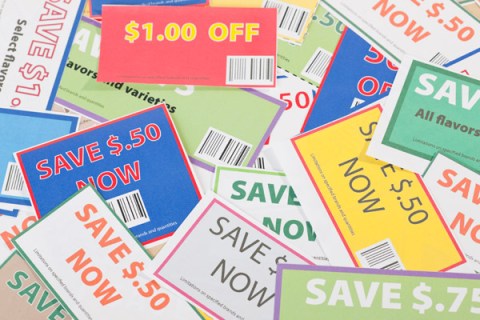
When researchers from the University of Arizona set out to study people’s couponing habits and motivations, they discovered that a significant number of the most die-hard coupon aficionados aren’t clipping out of financial need. Among the most extreme couponers — shoppers who report using six or more coupons on every single trip to the grocery store — 24% of them have household incomes of $75,000 or greater. Some are even richer: Nearly 5 percent have incomes of more than $150,000.While $75,000 may be considered affluent in some communities and barely middle-class in others, it’s still around 50% higher than the average annual household income in the United States.
“It was interesting for us to get a sense of who these high coupon users are,” says Anita Bhappu, professor and division chair in Retailing & Consumer Sciences at the University of Arizona, and lead researcher on the study. Of the 259 survey respondents, Bhappu says 26% are classified as heavy users; a total of 88% said they used coupons to some extent.
(MORE: Extreme Couponing: Never Hotter, Yet Never More Pointless)
Among the extreme couponers, 52% are female and 64% have kids at home. By contrast, 81% of people who say they never shop with coupons also don’t have kids. Interestingly, they’re also poorer; 61% have incomes of $35,000 or less.
“Clearly, the high coupon users represent the more affluent end of the range,” Bhappu says. But why people with higher incomes would be more drawn to extreme couponing remains a mystery.” One hypothesis could be people use coupons because they spend more money on groceries,” she says. “They’re feeding more mouths.”
Extreme couponers display other curious traits: They tend to buy whatever items are discounted via coupons, whereas people who say they never use coupons are more brand-loyal. Some non-users say they don’t bother with coupons because the discounts aren’t on items they would buy anyway. “Some said that when they adopted a healthier diet, the coupons stopped being valuable,” Bhappu says. “There’s a certain amount of lifestyle implications here.”
Just under a third of non-coupon users say that people who don’t use coupons are wasting their money, whereas nearly two-thirds of extreme couponers feel the same way. Among all types of users, 83 percent say they use coupons because this helps them save money. This view is higher among extreme couponers; a whopping 96 percent agree with the statement.
(MORE: The Latest Online Coupon Craze: Discounts on Stuff You Actually Need)
The most prolific coupon-clippers also don’t factor into their calculations the value of the time that their shopping strategy takes. “There’s a lot of time and effort that goes into reaping those savings, but they really never mention that side of it,” Bhappu says. People who don’t use coupons do the math differently.
“It seems like the non-users do an assessment of time and money — how much time did I have to put in to reap those savings? They’re very much making a judgment that takes the value of time into consideration,” she says.