


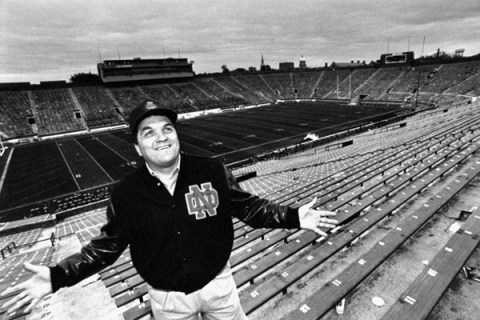
Former Notre Dame football player Daniel 'Rudy' Ruettiger Jr., standing with open arms in the empty stands at Notre Dame stadium, was charged with stock fraud by the Securities and Exchange Commission on Friday, December 16, 2011.
This time, Rudy got sacked.
Daniel “Rudy” Ruettiger, best known as the indomitable underdog who realized his dream of playing football at Notre Dame, was charged with deceiving investors Friday by the Securities and Exchange Commission for his role in a pump-and-dump stock scheme.
The SEC alleged that Ruettiger used his inspiring story and heroic reputation to trick investors into buying stock in his sports-drink company, a scheme that ultimately produced $11 million in ill-gotten gains for Ruettiger and a dozen other defendants. Ruettiger agreed to pay $382,866 to settle the charges without admitting or denying guilt in the case.
(MORE: Financial Scams Target Boomers)
Ruettiger became famous after his inspiring saga was dramatized in a 1993 movie starring Sean Astin. Despite his small size, (“five foot nothin’, 100 and nothin'”), Ruettiger became a walk-on player at Notre Dame, and eventually realized his dream of playing in an official game. In the film’s penultimate scene, Ruettiger was carried off the field by his teammates after sacking the opposing quarterback to secure the victory.
After Notre Dame, Ruettiger went on to become a motivational speaker, offering lessons from his inspiring biography to audiences around the country. According to officials, Ruettiger used his story and reputation as a way to convince people to invest in his sports-drink company, Rudy Nutrition, which had one product: a sports drink called “Rudy” with the tagline “Dream Big! Never Quit!”
(MORE: Consumers Already Returning Holiday Purchases)
However, according to the SEC’s complaint, “the company primarily served as a vehicle for a pump-and-dump scheme that occurred in 2008 and generated more than $11 million in illicit profits.”
“Investors were lured into the scheme by Mr. Ruettiger’s well-known, feel-good story but found themselves in a situation that did not have a happy ending,” Scott W. Friestad, an associate director in the S.E.C.’s enforcement unit, said in a statement. “The tall tales in this elaborate scheme included phony taste tests and other false information that was used to convince investors they were investing in something special.”