


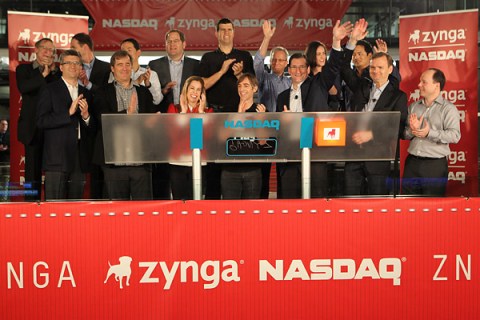
Zynga CEO Mark Pincus and colleagues gathered before the company began trading on the NASDAQ stock exchange Friday, December 16, 2011.
Online game-maker Zynga went public Friday, raising $1 billion in the biggest Internet IPO since Google in 2004. The company’s shares opened at $11 — 10% above the $10 offering price — before quickly falling as low as $9.50, then recovering. One hour after its debut as a public company, Zynga stock was trading sideways, essentially flat at about $10 per share.
Zynga’s lukewarm debut could mean a number of things. First, it could indicate that the company’s IPO underwriters, including Morgan Stanley and Goldman Sachs, accurately gauged market demand for the stock and priced the offering accordingly. It could mean that investors remain spooked after earlier Internet IPOs, such as Groupon and Pandora, spiked hard in first-day trading, only to eventually dip below the offering price. Or, it could simply mean that investors are not convinced about Zynga’s business model and prospects. After all, only 3% of the company’s users actually spend money on virtual goods, and the company remains highly dependent on Facebook, the platform on which the overwhelming majority of Zynga’s users play its games.
(MORE: Zynga’s Valuation Could Top $10 billion After IPO)
In truth, the fact that Zynga didn’t experience a dramatic first-day pop of 25% or more may not be such a bad thing, because expectations won’t be grossly inflated. Investors probably spend too much time obsessing about first-day IPO performance anyway — what really counts is how the company fares over the long-term. The key question for Zynga, which makes games such as Farmville, CityVille, and MafiaWars, is whether the company can increase its earnings to justify its valuation, now hovering around $7 billion. And investors will only be able to evaluate that after a few quarters of financial results.
One thing is for sure: Mark Pincus, who founded Zynga in 2007, is now a very rich man. His stake in the now-public company is worth over $1 billion. Pincus already pocketed $109 million earlier this year, after selling a small chunk of his stake back to the company.