



Over the past 10 years, our population growth has slowed, we’ve found it increasingly hard to leave home to start a career, and our salaries have decreased for the first time on record. But, it’s not all bad news.
The U.S. Census always provides fascinating data about the state of our country. But the numbers that have been trickling out of the 2010 Census this year show marked shifts, triggered largely by three factors: the Great Recession, an increase in immigration, and a rapidly aging population.
The data paints a picture of Two Americas, not necessarily between the haves and have-nots, but between older and younger Americas.
(MORE: Why Europe’s Downgrades Matter)
“Within the United States, there is a segmentation between older America, which is not receiving a lot of immigrants and where Baby Boomers are the dominant force, and the other part of the country, which is getting younger and becoming more diverse,” says Dr. William Frey, demographer and senior fellow at the Brookings Institution.
It’s a period of great change for the U.S., and it comes across in the numbers Census officials have been releasing this year. Here are five of the most surprising figures.
Source: US Decennial Census / American Community Survey / Brookings
1. We’re growing more slowly.
According to the 2010 Census, the 2000s were the slowest decade of population growth in 70 years. The country’s population only grew by 9.7%, a significant dip from the 13.1% growth in the 1990s.
“A lot of that is what a demographer would call the “aging momentum,” Frey says. Fewer Americans are in their child-bearing years, immigration is down and economic growth has slowed – all factoring into a dip in growth. The South and the West were still the nation’s leading regions in population growth, accounting for 23 million new residents, as opposed to 4 million in the Midwest and Northeast. Still, even with the decrease, the U.S. added the equivalent of 80% of Canada’s population since 2000.
2. We can’t leave home.
Americans are increasingly stuck at home and less mobile than in years past. The percentage of Americans who moved in 2011 hit 11.6%, the lowest that figure has been since the 1950s.
“It’s the Avenue Q generation,” says Frey, referring to the Broadway musical about unhappy New Yorkers who aren’t able to move to other cities. “But this migration issue is very much a short-term problem. It’s mostly young people in their 20s and 30s who are staying home or moving back in with their parents.” Historically, recent grads are the ones most likely to pack up and leave home for better jobs. The problem is that the mobility issue is a vicious cycle: Americans can’t pack up and move because of the poor economy, and the economy is poor because people can’t pack up and move. But once things do get better, expect those mobility numbers to rise.
3. We’re closer to becoming a “majority minority” nation.
The rise in minority populations in the U.S. is quickening, and by 2040, Census officials project that the country will hit that majority minority mark. “In infants,” says Frey, “we’re already at a majority minority.”
(MORE: Stop Changing the Oil Every 3,000 Miles Already)
Non-whites, largely Hispanics and Asians, made up 92% of population growth in the last decade, and many of them are moving into large metro areas or the suburbs. Minorities now consist of more than half the population in 22 large U.S. cities, an increase from 14 metro areas in 2000 and only five in 1990. And according to Census figures, a majority of every major racial and ethnic group in large cities now lives in the suburbs.
4. We’re getting older.
Yes, all of us are getting older. But as Baby Boomers age, the U.S.’s 45-and-over population has grown more than 18 times faster than the group that is currently under 45. Many cities, including Buffalo and Cleveland, are aging; while others, like Raleigh and Las Vegas, are experiencing an influx of younger Americans. And older Americans are moving to the suburbs, where 40% of the population is now 45 and older. (In fact, about half of all Americans now live in the suburbs.)
And a note to those running for political office next year: Half of all voting age Americans are now over 45 years old.
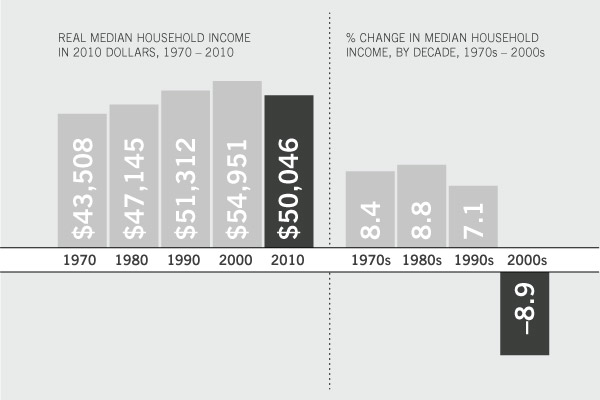
5. We’re not making as much money as we were 10 years ago.
In what might be the most startling finding to come out of the 2010 census, real median household income fell for the first time on record. In 2010, the typical household earned $49,445, a decrease of 7% from 2000, while poverty climbed to 15.1% of the population, the highest since 1993.
“The 2008 recession and the period afterward were a much more severe economic downturn than we’ve seen,” says Howard Wial, a fellow and economist at the Brookings Institution, in explaining the dip in household income. “And the recovery we had from the 2001 recession was sluggish. So we had a very severe recession like nothing we’ve ever seen following a period of pretty slow growth.”
While it’s difficult to project with accuracy what might happen by the time the next Census rolls around, Wial sees a long climb ahead for the U.S. economy.
“It’s hard to make predictions 10 years ahead,” he says. “But so far it’s been a very tepid recovery, and I think it’s going to continue that way for another couple of years.”