


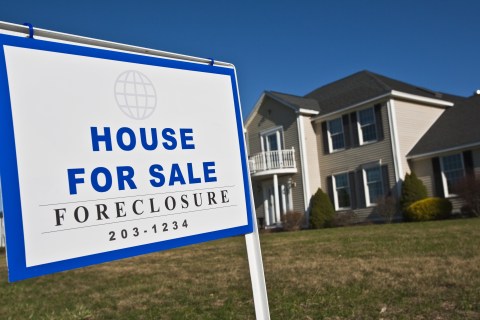
The social stigma of going into foreclosure seems to have decreased in the last few years as almost three-quarters of U.S. households found themselves underwater with their mortgages, and “walking away” from a home became commonplace. However, two recently released figures suggest that homeowners feel a renewed sense of financial obligation to their homes and are more likely to be paying their bills.
The Mortgage Bankers Association announced on Wednesday that mortgage applications jumped 23% from last week, with the increase primarily driven from a surge in refinancing applications. Loan modifications made up 82.2% of the applications, which is up from 80.8% the previous week, and which represents the highest levels since August. Presumably, homeowners keen on walking away wouldn’t bother with loan modifications, so the rise in applications can be viewed as a sign more owners are invested in their homes for the long haul.
“With mortgage rates reaching new lows, refinance volume jumped,” said Michael Fratantoni, MBA vice president. “Purchase activity also increased as buyers returned to the market after the holiday season.” Fratantoni also argued that concerns about the economic situation in Europe are keeping interest rates low. Interest on a 30-year-fixed-rate mortgage ranges from 4.06% to 4.11% today.
(MORE: The Number of ‘Improving’ Housing Markets Nearly Doubles)
While the Federal Reserve has announced that rates will remain low at least until 2013, homeowners seem to be grasping the notion that these historically low rates won’t be here forever. In fact, when the Fed meets next Tuesday and Wednesday, the issue of how to go about future rate hikes will be addressed.
Meanwhile, Standard & Poor’s and Experian released an index on credit defaults indicating that mortgage defaults are decreasing. For December 2011, the default rate on a first mortgage measured 2.19% nationwide, down from 2.93% the previous December.
While mortgage defaults rose slightly for the fourth quarter of 2011, analysts believe that December’s downward trend of consumer defaults will continue in 2012. From first mortgages to bank cards and auto loans, credit default rates have all decreased, making the composite default rate drop from 3.01% in December 2010 to 2.24% in December last year.
What the numbers tell us is that more and more homeowners are honoring their financial commitments. However, before taking too much comfort in the data, we should realize that two troubling issues remain.
First, it looks like some homeowners are dipping into savings to keep up with mortgage payments and meet other financial obligations. A study released at the end of 2011 by the U.S. Commerce Department reported that average savings decreased to 3.5%, down from 5.1% the previous year. Second, as Reuters reported:
American households “have been spending recently in a way that did not seem in line with income growth. So somehow they’ve been doing that through perhaps additional credit card usage,” Chicago Federal Reserve President Charles Evans said on Friday.
“If they saw future income and employment increasing strongly then that would be reasonable. But I don’t see that. So I’ve been puzzled by this,” he said.
(MORE: In November, We Racked Up $5.6 Billion More Credit Card Debt)
This sort of puzzling behavior could create new problems, including an easily imagined scenario in which more households have a worrisome combination of depleted savings accounts and freshly accrued credit-card debt.
Katherine “Katie” Tarbox serves as a senior editor for REALTOR Magazine and is the author of the international bestselling book A Girl’s Life Online. She’s an active marathon runner and climbed on two of the seven summits, Kilimanjaro and Everest. Follow her @katherinetarbox or katherinetarbox.com.