


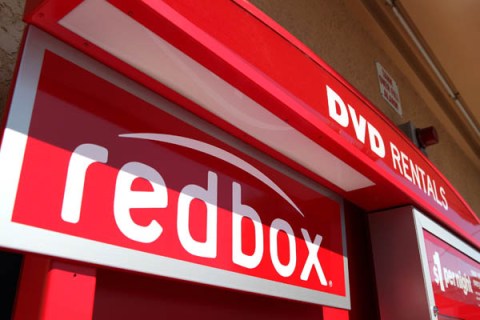
A just-announced joint venture between Verizon and Redbox will soon offer a service combining video streaming and physical DVD rentals. Now wait just a sec. Isn’t there some company that already does both of those things?
Ah yes, Netflix! After a tumultuous summer for Netflix after it raised its prices, the business was nearly split in two, and the stock price fell off a cliff, those in the visual entertainment field have been trying to kick the company—and steal away customers—while it’s down. Blockbuster-Dish Network and Amazon both introduced or expanded video streaming options, and now, there’s the announcement of the Redbox Verizon Project.
The venture will be introduced to the public in the second half of 2012. Hopefully, by then, the official name of the service will be a little catchier than the Redbox Verizon Project, which sounds as if a couple of corporate executives formed a ’70s-like rock band that leaned heavily on extended synthesizer jams. Hopefully, the name is better than Qwikster too.
(MORE: Cord Cutting: The Sensitive Guy’s Guide to Breaking Up With Cable TV)
For now, the Verizon-Redbox service is lacking not only a name, but many, many specifics. A new video streaming service is a certainty. Other than that, much is unclear. Here’s a quote from the press release:
“When you consider the core elements the parties bring to this venture – our powerful brands; our national rental kiosk footprint; our anytime, anywhere network presence; and our mutual commitment to customer-focused innovation – it’s clear that Verizon and Redbox are a powerful entertainment team,” said Bob Mudge, president of Verizon consumer and mass business markets.
Given that the new parties involved provide the two core features offered by Netflix (streaming and DVDs), it’s also clear that Verizon and Redbox have Netflix squarely in the crosshairs.
As coincidence has it, over the weekend the Los Angeles Times published a story about how Netflix has been slowly but steadily placing more emphasis on TV programming. At least partially because access to the newest Hollywood films has gotten increasingly expensive, Netflix has shifted the focus more toward TV shows. It’s developing its own shows (“House of Cards”) and buying exclusive rights to others (“Lilyhammer”). In the past, over 80% of Netflix content was movies. But in recent months, 60% of what’s streamed by Netflix subscribers originated on TV.
(MORE: The Wait Time for Movies from Redbox and Netflix Just Doubled)
What’s particularly interesting about these developments is that, for quite some time, pay TV providers swore that they weren’t competing with Netflix for customers, and vice versa. Cable executives consistently contended that Netflix wasn’t much of a threat to their businesses, and many interested parties have often made the case that Netflix and pay TV are complementary services rather than direct competitors.
But come on. Who are they kidding? Though it sometimes seems like the consumer appetite for visual entertainment is limitless, there are only so many shows and movies one can watch, and only so many monthly bills one can handle. At some point, the consumer faces an either/or proposition, not both.
Brad Tuttle is a reporter at TIME. Find him on Twitter at @bradrtuttle. You can also continue the discussion on TIME’s Facebook page and on Twitter at @TIME.