


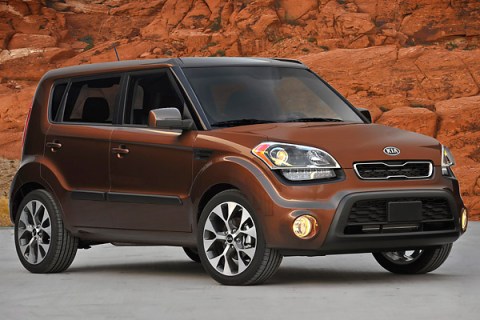
Kelley Blue Book named the Kia Soul as its "Lowest Cost of Ownership" winner in the compact car category.
In a study evaluating the total costs of owning a car—including initial price, as well as likely fuel expenditures and expected maintenance and depreciation—Kia has been crowned as the overall lowest-projected-cost champ.
Kelley Blue Book has just announced its first-ever “Total Cost of Ownership Award Winners,” with victors declared in different car categories (mid-size, luxury, minivan, etc.) and overall brand winners as well.
For consumers, the existence of such awards should be a reminder that the car with the cheapest upfront MSRP may not necessarily be the car that costs the least in the long run. KBB’s expert points out:
“Car shoppers should take the time to compare vehicles on their consideration lists to fully understand the financial implications involved with cost of ownership,” said Juan Flores, director of vehicle valuation for Kelley Blue Book. “While a vehicle might be less expensive up front, the cost of fuel for that model, insurance and other expenditures could make it the less appealing choice for their wallet in the long run.”
(MORE: King of the Road: The 2012 Cars with the Most Bang for the Buck)
Of the 21 individual car categories in KBB’s awards, Kia, the second-largest automaker from South Korea (after Hyundai), won in just one case: Kia Soul, in the compact car category. Nonetheless, because so many other Kias scored well in several other categories, the automaker earned the title as the “2012 Total Cost of Ownership: Brand” champion.
Audi, meanwhile, which won in two individual categories (luxury car and luxury sport utility) had the lowest cost of ownership among luxury brands.
As with any “best value” awards, KBB’s are imperfect. While cars are grouped into various categories so as to compare apples to apples, sometimes vehicles that are quite different from each other are lumped into the same category.
Take the minivan category. KBB’s lowest-cost-of-ownership winner is the Mazda 5. There’s no disputing this automobile is less expensive to own than other minivans, but there’s an argument to be made that this automobile isn’t really a minivan at all. The typical minivan, such as the Honda Odyssey or the Chrysler Town & Country, has seating for seven. The Mazda 5 seats only six. The Toyota Sienna, another mainstream minivan, is 200 inches long and 78 inches wide, versus 180.5 inches and 69 inches with the Mazda 5.
(MORE: All Signs Point to a Big Year for Car Sales: New Cars, Used Cars, You Name It)
The point is: The Mazda 5 may be cheaper to buy and own than the typical minivan, but it’s also a lot less car than the typical minivan.
So, as with “best value” awards, it’s smart to examine the results carefully. It’s also a good idea to consult more than one “best of” lists—U.S. News and Consumer Reports, for example, published their own awards not long ago.
Brad Tuttle is a reporter at TIME. Find him on Twitter at @bradrtuttle. You can also continue the discussion on TIME’s Facebook page and on Twitter at @TIME.