


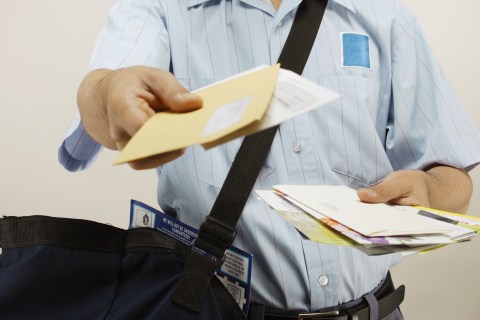
By 2015, the U.S. Postal Service says it could be losing $18.2 billion annually. To stop the bleeding, it has proposed several money-saving strategies, including closing hundreds of post offices and processing facilities, canceling Saturday delivery, and now, the plain old-fashioned technique of jacking up the price of a stamp.
Once upon a time, the volume of mail could be expected to grow at an even faster pace than the population. In 1953, 50 billion pieces of mail were delivered in the U.S. By 1966, the figure had ballooned to 75 billion. Thanks to the Internet, and particularly due to the soaring popularity of paying bills online, snail mail has been a dying industry of late: Last year, there was a 1.7% decline in mail volume.
The Postal Service, which expects to lose $14.1 billion in the fiscal year ending in September 2012, and bigger losses in the years to come, has responded with several proposals, and most suggestions make the service it provides worse. It has slowed down first-class mail delivery, and closing offices and canceling Saturday delivery will only slow it down further.
(MORE: How the U.S. Postal Service Fell Apart)
When facing declining customer interest, most businesses try to make their products more compelling, or at least cheaper. Instead, the Postal Service insists that, even as fewer and fewer people are mailing letters, the prices being charged aren’t high enough. On Thursday, postal officials sent a letter to Congress recommending several changes, including the possibility of increasing the price of a stamp to 50¢. Chief financial officer Joe Corbett was quoted by the Associated Press saying:
“Clearly, we’re underpriced in that area,” Corbett said. “We would like the ability to move that price up.”
As recently as 2006, the price of a stamp was 39¢. Since then, it’s been raised four times, and a stamp currently costs 45¢. According to the Postal Service’s new plan, tacking on another nickel to the price of a stamp would raise revenues by $1 billion annually. The price hike could go into effect all at once, but more likely would creep up in one- or two-penny increments, before reaching the half-dollar mark by 2015.
(MORE: Will Post Office Cuts Cost You Credit Card Late Fees?)
Defenders of the Postal Service love to point out that taxpayers don’t foot the bills for the post office. But in his address to Congress, Postmaster General Patrick Donahoe pleaded with government officials to help the Postal Service to raise revenues and limit losses. Inaction, Donahoe said, would result in a “long-term burden to the American taxpayer.”
Brad Tuttle is a reporter at TIME. Find him on Twitter at @bradrtuttle. You can also continue the discussion on TIME’s Facebook page and on Twitter at @TIME.