


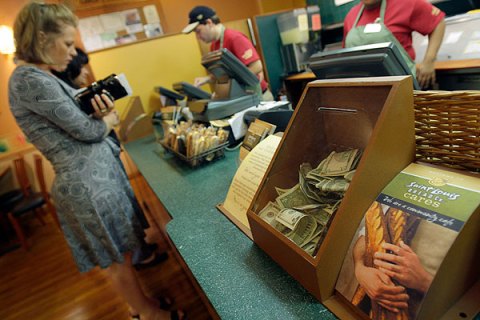
Customers order food as a cash box sits on the counter at a Panera Bread Co. restaurant in Clayton, Mo., May 18, 2010.
Who knew asking people to pay whatever they wanted for a sandwich or a cup or soup would prove to be a successful business model? Panera Bread’s nonprofit arm generated some buzz in 2010 when it announced an unusual concept: Rather than having fixed prices, the menu at “Saint Louis Bread Company Cares” in Clayton, Missouri, would have suggested donation amounts. It’s a model that’s more typical for museums than sandwich shops — but crazily enough, it works. Now the Panera Bread Foundation is expanding on this unconventional restaurant model.
The company told the Detroit Free Press that around 60% of patrons pay the suggested price (which is the regular menu price) at the “Panera Cares” branch in Dearborn, Michigan, which opened in late 2010. And around 20% of customers actually pay more than the suggested price. These deep-pocketed diners help subsidize the remaining 20% who won’t — or can’t — pay full freight.
(MORE: Celeb Schwag: Famous People Get $100K Worth of Free Stuff Annually)
The cafes are meant to be community outreach locations where the hungry can go for a meal that costs as much or as little as they can spare.
These are no run-down soup kitchens. Inside, the cafes look like a typical Panera location. The big difference is at the cash register. Customers are given bills with suggested donation amounts, and they’re free to put whatever they want into a donation box. People who can’t pay also have the option of volunteering their time.
(MORE: GiveDirectly: A Charity That Just Gives Money to Poor People, So They’re Not So Poor)
Now Panera executive chairman Ron Shaich says he’s committed to adding Panera Cares cafes in more cities around the U.S., despite some challenges. A third location that opened in Portland, Oregon, early last year pulled in about 25% less than the other two locations, not enough to cover operating costs. Shaich told the Portland Tribune last fall that “a sense of entitlement” was to blame.
But the problem was solved when the company to hire a community outreach specialist to talk to the cafe’s patrons on a daily basis. College students were told it was inappropriate to grab a daily lunch and just pay a buck or two; homeless patrons were asked not to bring all of their belongings and essentially camp out in the cafe. Shaich told the paper that once people grasped the idea that the cafe was supposed to be a resource for the needy in the community, they started pitching in and stopped taking the freebies for granted.
MORE: Special Delivery
SPECIAL: Big Ideas for Small Business