


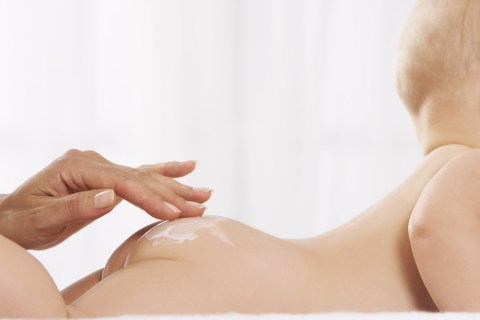
Joining the ever-growing list of odd economic indicators that includes the hot waitress index and men’s underwear index, here’s one that might be called the diaper rash index. Over the past couple of years, sales of disposable diapers have fallen at the same time that diaper rash cream sales have increased. And the explanation being given for these consumer shifts? Parents are changing their kids’ diapers less frequently, perhaps out of a desire to save money. The result is an epidemic of irritated baby bottoms.
Ad Age has proposed the theory that the economy is to blame for American baby bottoms being in worse shape than, well, the economy. There are two key components presented to make the argument:
1) Over the past year, unit sales of disposable diapers fell 9%, or three times faster than the decrease in the number of babies 2 and under in the U.S. (For that matter, the decreases in babies born and babies planned can themselves be seen as signs of a struggling economy.)
2) Over the same time period, sales of diaper rash creams and ointments have risen 2.8% in the U.S., despite the 3% decrease in the number of American children in the diaper demographic.
The conclusion being reached is this:
Data suggest that babies are getting diaper rash more often because parents are changing their diapers less.
Could it also be that parents are changing diapers less frequently to trim the estimated $1,500 per year it costs to diaper one’s child? That’s the theory presented.
There are other explanations, of course. The decrease in disposable diaper sales could be related to a rise in cloth (non-disposable) diapers, or a rise in parents potty training their kids earlier. The rise in diaper cream sales could be the result of more aggressive marketing efforts from manufacturers and retailers. Even if parents are changing their children’s diapers less often, they might not necessarily be making such, um, rash decisions in the hopes of saving money. It could be that parents are more distracted lately—concerns about the economy have something to do with it—and they’re so preoccupied that they don’t get around to changing their kids’ diaper in an ideal and timely fashion.
(LIST: 12 Things You Should Stop Buying Now)
In any event, it should be apparent that scaling back on diaper changes fails as a money-saving strategy. In all likelihood, any money a parent saves by purchasing fewer diapers will wind up being spent on diaper cream. Decreasing the frequency of diaper changes is also just plain mean and unwise. Ultimately, it’s the kid with diaper rash who suffers—and so does everyone within earshot of the agitated baby.
Brad Tuttle is a reporter at TIME. Find him on Twitter at @bradrtuttle. You can also continue the discussion on TIME’s Facebook page and on Twitter at @TIME.